
Reliability Engineering – The Edge You Need
In today’s fast paced and competitive industrial landscape, operational excellence is defined by how often it breaks. In other words, how reliably it performs. Every unplanned breakdown affects production, increases operating costs, introduces safety risks and erodes customer confidence. Reliability Engineering provide organizations with a structured approach to anticipate potential failures, optimize asset performance and transform equipment reliability into a competitive edge.
Reliability Engineering is the discipline of ensuring assets perform their intended function under specified conditions for a pre-defined time. For asset-intensive industries such as manufacturing, energy, mining, and utilities, it directly influences profitability.
The True Cost Of A Breakdown
When an asset fails, the visible repair cost is usually the smallest expense. The real cost lies in everything that follows. A single failure can trigger.
- Lost production hours and missed deliveries.
- Overtime labor and emergency procurement.
- Product quality losses and safety risks.
- Increased inventory and reduced equipment life.
Reliability engineering focuses on preventing these business losses by identifying failure mechanisms before they interrupt operations.
The Right Time For Reliability
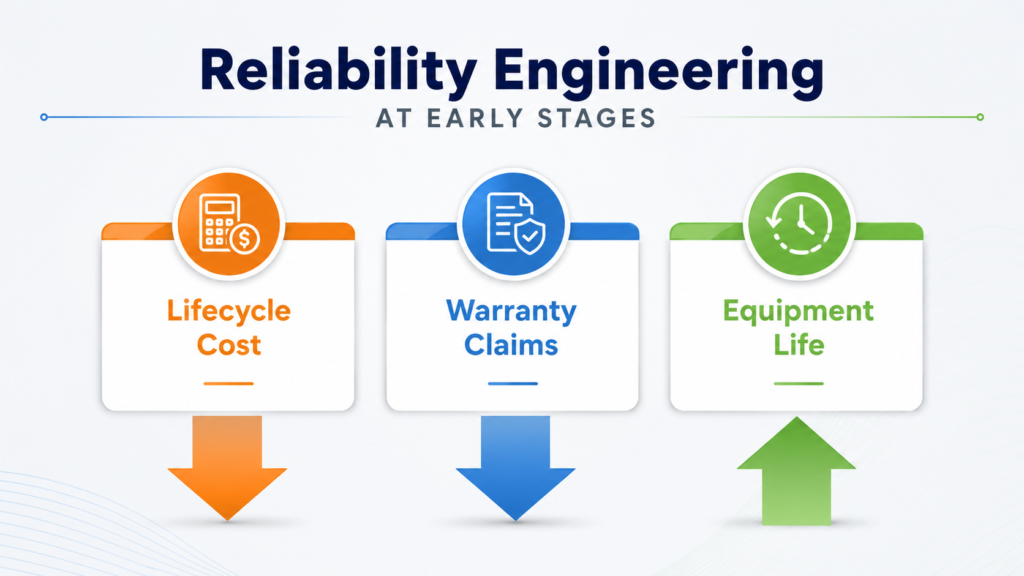
Ideally, Reliability is designed into the system from the initial stage. Decisions regarding material selection, operating loads, and redundancy determine Asset performance. Once the asset enters service, maintenance can preserve reliability, but it cannot fully compensate for poor design choices. Organizations that involve reliability engineers during the design phase experience lower lifecycle costs, fewer warranty claims, and longer asset life.
The Reliability Toolkit: Moving From Reactive To Proactive
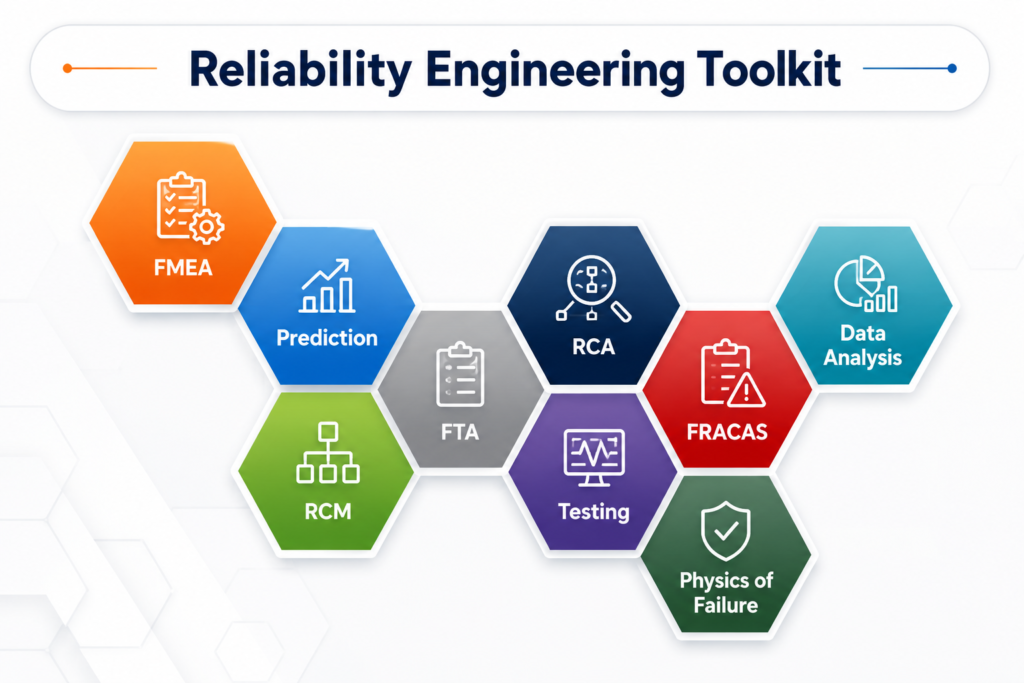
Reliability engineering relies on proven analytical tools, not guesswork. The core methodologies include:
Failure Modes and Effects Analysis (FMEA): Identifies potential failure mechanisms and their operational impacts before they occur, allowing teams to reduce risk during design or operation.
Reliability Prediction: Uses industry standards (mathematical models) to quantitatively predict failure rates during the design phase. This enables engineers to compare design alternatives, identify weak components, and achieve reliability targets before building physical prototypes.
Physics of Failure: Goes beyond statistical models to understand how and why materials and components degrade at the microscopic level, whether through fatigue, corrosion, wear, or thermal stress. This knowledge enables targeted design improvements rather than trial-and-error fixes.
Reliability-Centered Maintenance (RCM): Evaluates each failure mode to select the most cost-effective failure management strategy (e.g., scheduled maintenance, condition monitoring, or even run-to-failure), aligning maintenance with actual business risks.
Fault Tree Analysis (FTA): A top-down deductive method that models how component failures, human errors, safety issues and external events combine to cause system-level failures. FTA helps quantify the probability of critical failures and identifies single points of failure that need redundancy or design changes.
FRACAS (Failure Reporting, Analysis, and Corrective Action System): A closed-loop process that systematically captures failure data, analyzes trends, finds root causes, implements corrective actions, and verifies their effectiveness. FRACAS turns every failure into a learning opportunity by eliminating the failure permanently.
Root Cause Analysis (RCA): Stops the cycle of recurring failures. Instead of just asking “What failed?”, RCA asks “Why did it fail?” to address technical and organizational root causes. There are a number of RCA techniques to work from depending on the nature of failure. Some of the notable RCA techniques are “Fault Tree Analysis”, “5 Whys”, “Fishbone” and “Pareto”.
Reliability Data Analysis: Converts valuable input from work orders, vibration data, oil analysis, and operational history into actionable insights using statistical techniques like Weibull analysis, reliability growth modeling, condition-based maintenance and predictive maintenance. Assets can outperform with the availability of data-driven decisions through reliability data analysis as opposed to engineering judgment and assumptions.
Reliability Testing (HALT/HASS/ALT): The process of checking whether an Asset or product performs consistently without failure over a specified period under given conditions. These tests are carried out once the prototype or physical design is to be finalized and is about to enter the production stage. Some of the reliability tests depending on their outcome and requirement are provided here.
- ALT (Accelerated Life Testing) uses elevated stress conditions to predict product life under normal operating conditions and performed early in the design stage.
- HALT (Highly Accelerated Life Testing) pushes products beyond design limits to uncover weaknesses early during the final design stage.
- HASS (Highly Accelerated Stress Screening) screens production units to catch manufacturing defects before the produced unit is shipped to the customer.
What Is Not Reliability
Some of the misconceptions that have been developed in industries over the years are:
Treating maintenance as reliability: Maintenance restores equipment; reliability engineering improves its performance. They are complementary, not interchangeable.
Hoarding data without analyzing it: A CMMS stores valuable information, but value is only created when that data is analyzed and translated into action.
Over-maintaining assets: More maintenance doesn’t equal better reliability. Unnecessary interventions can actually introduce new failure mechanisms and drive-up costs.
Ignoring design flaws: Repeated failures usually indicate a design limitation, not a maintenance deficiency. Fix the engineering issue for long-term value.
Key Benefits Of Reliability Engineering
Reliability engineering is not a one-time initiative but a continuous cycle of learning and optimization. Organizations that embed it into their operational strategy consistently achieve:
- Reduced unplanned downtime and lower maintenance spend.
- Higher production availability and equipment utilization.
- Extended asset life and reduced inventory requirements.
- Improved safety and higher customer satisfaction.
Why Choose Us
At QVISE, we offer complete Reliability Engineering consulting and solutions to help organizations improve asset reliability, maximize equipment availability and optimize lifecycle performance. We offer consulting services aligned to your specific operational objectives, industry requirements and business priorities, providing practical, measurable and sustainable improvements in reliability, maintenance effectiveness and overall operational performance.
We also offer standard, customized and closed-loop Reliability Engineering training programs to empower maintenance, engineering and operations teams to apply reliability best practices using the knowledge and practical skills provided.